

Breaking: U.S. strikes IRGC targets in Iran; Trump warns of harder retaliation
- •
- •


WASHINGTON — U.S. Central Command said U.S. forces began striking Islamic Revolutionary Guard Corps targets in Iran at 12 p.m. ET Tuesday, Sept. 1, 2026, a new wave of attacks distinct from Sunday’s limited strike on Larak Island and coming after oil tankers were hit in the Strait of Hormuz and Iran fired on American positions in Jordan.
In a post on X, CENTCOM wrote: “Today at 12 p.m. ET, U.S. forces began striking Islamic Revolutionary Guard Corps (IRGC) targets in Iran. The strikes follow recent attempted attacks by the IRGC against commercial shipping in the Strait of Hormuz and against American service members deployed to the region.” The statement did not list target sites, aircraft used, or battle-damage assessments.
Today at 12 p.m. ET, U.S. forces began striking Islamic Revolutionary Guard Corps (IRGC) targets in Iran. The strikes follow recent attempted attacks by the IRGC against commercial shipping in the Strait of Hormuz and against American service members deployed to the region.
— U.S. Central Command (@CENTCOM) September 1, 2026
President Donald Trump, posting on Truth Social, said the United States was “as we speak, striking Iranian Targets near the Strait of Hormuz,” calling the strikes “large and powerful” and framing them as retaliation for what he described as Iran’s failed attempt to place sea mines in the strait and for firing missiles at a U.S. base in Jordan. He warned Tehran against answering the raid.
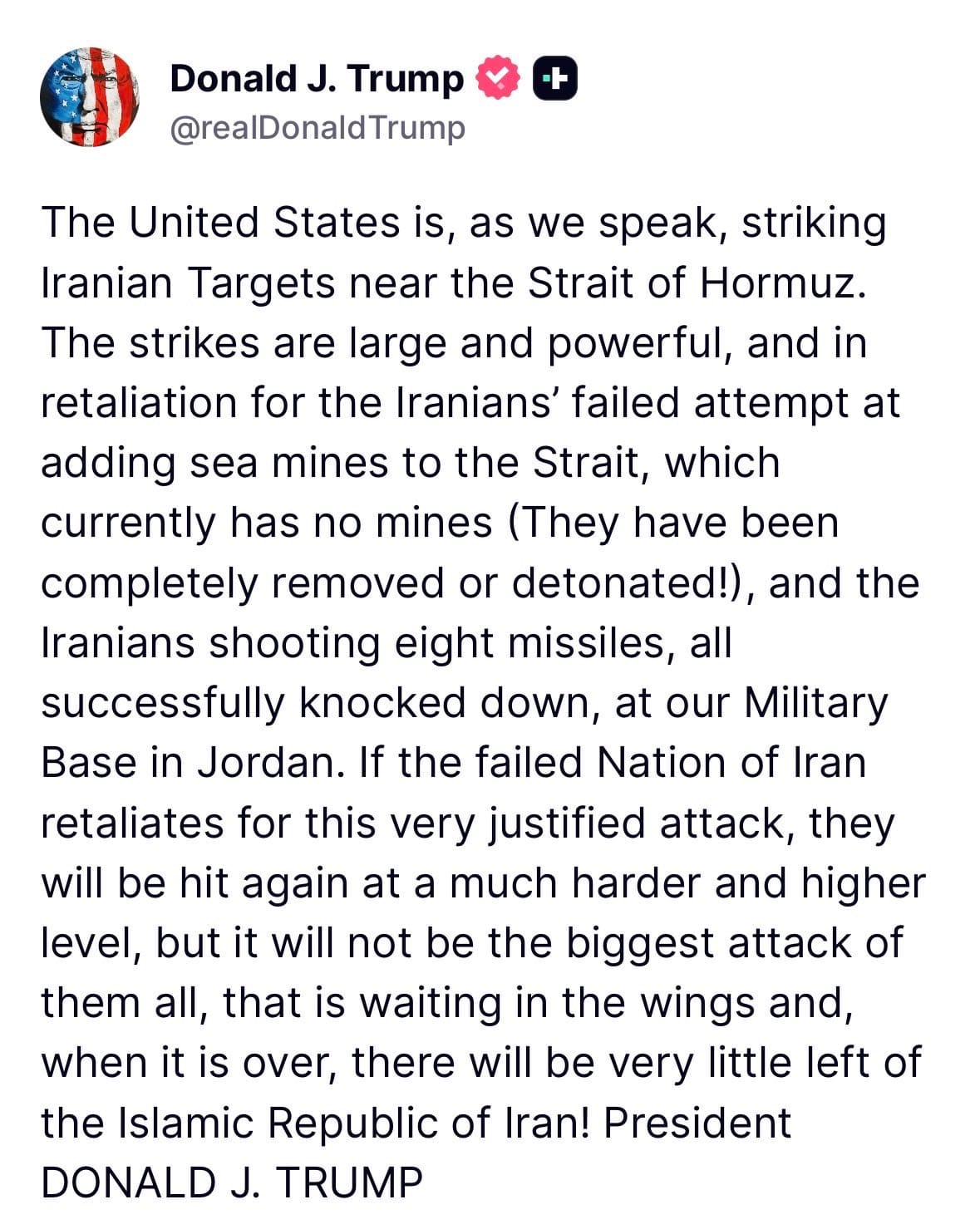
In that Truth Social post, Trump wrote: “If the failed Nation of Iran retaliates for this very justified attack, they will be hit again at a much harder and higher level, but it will not be the biggest attack of them all, that is waiting in the wings and, when it is over, there will be very little left of the Islamic Republic of Iran!” That language is Trump’s claim about U.S. intent; CENTCOM’s Tuesday notice was narrower and did not echo the “biggest attack” threat.
Iranian state media, via IRNA and reported in CBS News live updates Tuesday, said four projectiles hit areas in Chabahar and Konarak counties in Sistan-Baluchistan province, east of the Strait of Hormuz, citing provincial official Ali Khalilabadi. IRNA did not specify damage. Independent confirmation of those impact sites was not available at publication.
Oil prices rose on the renewed fighting. CNBC reported Brent crude futures up about 3.8% to $93.89 a barrel Tuesday and U.S. West Texas Intermediate up about 3.7% to $89.41, the highest WTI level since July 24 on that account. CBS’s earlier Tuesday oil update had Brent trading over $92.
Sunday Larak, then Jordan, then tankers
Tuesday’s CENTCOM announcement is a separate operation from Sunday’s strike on Iran’s Larak Island. Capt. Tim Hawkins, a CENTCOM spokesman, said U.S. forces struck two Iranian rocket launchers on Larak after IRGC units were observed preparing to launch rockets carrying sea mines into the Strait of Hormuz. CENTCOM called that action “limited” and “precise.” IRNA said two people were killed on Larak; some wire accounts put the Iranian death toll at up to three. Those casualty figures are Iranian or wire attributions, not independently verified here.
Iran answered by firing ballistic missiles at U.S. bases in Jordan that Iranian media identified as King Hussein and Al-Azraq. Jordan’s military said it intercepted eight missiles, according to Jordanian and U.S. reporting carried by CBS and NBC. The IRGC also claimed a drone attack involving the UAE; the UAE said at least one drone was engaged. On Monday, Trump told Fox News, “We’re going to hit them hard,” and said there would be “a response,” as previously reported.
Late Monday, two Saudi-loaded crude tankers — the Sidr and the Senegal Prosperity — were struck by projectiles near Khasab, Oman, according to Marisks and UKMTO reporting. Insanity Developing covered that incident separately; see Two Saudi-loaded oil tankers struck by projectiles in Strait of Hormuz. No public claim of responsibility for those tanker hits was reported in Tuesday wires.
Six-month war, executive power
The exchange sits inside a six-month U.S.–Iran war that has repeatedly centered on the Strait of Hormuz, a chokepoint for global oil. Washington says it is protecting commercial shipping and enforcing a naval pressure campaign; Tehran rejects U.S. claims of control and has answered with missiles, mines threats, and economic counter-pressure. Neither CENTCOM’s Tuesday notice nor Trump’s Truth Social post cited a new congressional authorization. The decision to widen strikes again rests with the president as commander in chief — the same concentrated executive war power that has run this conflict since February without a fresh, war-specific vote from Congress.
What is confirmed tonight is the sequence CENTCOM and Iranian state media put on the record: new U.S. strikes on IRGC targets beginning midday Eastern Time Tuesday; Iranian reports of impacts in southeastern Iran; Trump’s public threat of harder follow-on attacks if Iran retaliates. What is not confirmed is the full target list, Iranian military losses, or whether either side intends a return to sustained, nightly bombardment versus another limited tit-for-tat cycle around Hormuz.
Sources
- U.S. Central Command on X, Sept. 1, 2026 (status 2094826294466810366)
- President Donald J. Trump on Truth Social, Sept. 1, 2026
- CBS News live updates, Sept. 1, 2026 (IRNA on Chabahar/Konarak; oil; Larak and Jordan timeline)
- CNBC, Sept. 1, 2026 (Brent and WTI prices; CENTCOM confirmation)
- Insanity Developing prior reporting on Monday’s tanker strikes and Monday’s Larak/Jordan exchange


Discussion